


Recycled vs Virgin Polyester: Performance Comparison
Table of Contents
- What Makes Recycled Polyester and Virgin Polyester Different
- Recycled Polyester Durability and Abrasion Resistance
- Recycled Polyester Moisture Wicking and Drying Performance
- Stretch, Strength, and Fabric Feel
- Color Retention and Long-Term Appearance
- Recycled Polyester Microplastics and Shedding
- Recycled Polyester Certification and Supply Chain Verification
- Environmental Impact and Life-Cycle Comparison
- Frequently Asked Questions
Last Updated: October 12, 2026
What Makes Recycled Polyester and Virgin Polyester Different
Recycled polyester performance depends on where the fiber came from and how it was processed.
At Hippie Golf LLC, we focus on recycled polyester because recycled polyester performance delivers the same technical benefits as virgin fabric while using fewer resources.
Virgin polyester is synthesized from petroleum through an energy- and water-intensive process.
How Virgin Polyester Is Made
Virgin polyester begins with crude oil extraction. The oil is refined into ethylene glycol and terephthalic acid, polymerized into long chains, melted, extruded through spinnerets, and cooled into filament yarn, then woven or knitted into fabric.
It's energy-intensive, requiring heat, pressure, and chemical catalysts. The resulting fabric is consistent and durable, with no degradation from previous cycles.
How Recycled Polyester Is Made
Recycled polyester starts with collected plastic bottles and textile waste, sorted, cleaned, and shredded into flakes, then melted and re-polymerized into new filament, mechanical recycling when the polymer structure is preserved, chemical when it's fully deconstructed and rebuilt.
Chemical recycling produces virgin-quality fiber; mechanical recycling is faster and less energy-intensive but can shorten polymer chains, slightly affecting durability over many washes. Both perform comparably to virgin in most applications.
The key advantage: recycled polyester skips crude oil extraction and initial polymerization, where virgin polyester consumes the most energy and water.
Recycled Polyester Durability and Abrasion Resistance
Durability is where the recycled-versus-virgin conversation gets fuzzy, so let's pull it apart like a well-struck drive.
Start with the fiber. Virgin polyester is polymerized from petroleum-derived precursors into long, uniform chains, then melt-spun into filament yarn.
Now the part that actually decides your garment's fate: construction. Fiber length matters far less than these variables:
- Fabric weight. A 4.9 oz/yd² knit has more material per square inch to absorb abrasion than a 3.24 oz/yd² featherweight. Lighter fabrics trade rub resistance for breathability, a fair deal in hot weather, a poor one for a work shirt.
- Knit or weave density. Tight, dense constructions resist snagging and pilling because individual yarns can't work loose as easily. Loosely knit fabrics shed fibers and pill faster regardless of fiber origin.
- Yarn type. Filament yarns (continuous strands) resist pilling better than spun yarns (short staple fibers twisted together), because there are fewer loose fiber ends to tangle into pills.
A tightly knit recycled polyester polo outlasts a loosely knit virgin polyester tee by a wide margin.
Abrasion bites at cuffs, collar edges, underarm seams, and anywhere a bag strap or club grip rubs.
A Quick Decision Matrix by Use Case
Because "it depends" is only useful if you know what it depends on, here's a practical read on when recycled polyester is a clear win, when virgin still has an edge, and when it's a wash:
| Use case | Recycled polyester | Virgin polyester | Bottom line |
|---|---|---|---|
| Everyday apparel & polos | Excellent | Excellent | Wash, pick on construction and style |
| Golf & light sportswear | Excellent | Excellent | Wash, denser knits win either way |
| Hot-weather activewear | Excellent | Excellent | Wash, go lighter weight, either fiber |
| Heavy workwear / high abrasion | Good | Slightly better | Virgin may edge out on lifespan |
| High-compression athletic gear | Good | Slightly better | Virgin for max durability |
| Outdoor gear (packs, shells) | Good | Slightly better | Virgin for abrasion-critical panels |
| Fashion / low-wear pieces | Excellent | Excellent | Recycled, for the lower footprint |
One caveat: the table assumes comparable fabric weight and construction. Change the construction and you can flip any row, a heavyweight recycled knit beats a lightweight virgin one every time.
What to Look For on the Label
If durability is your priority, these signals matter more than the word "recycled":
- Fabric weight in oz/yd², heavier generally means more abrasion resistance.
- Knit or weave description, dense, tight constructions resist pilling and snagging.
- Yarn type, filament yarns tend to pill less than spun yarns.
At Hippie Golf LLC, our recycled performance polos use dense knit construction because it holds shape and resists snagging through seasons of play, the fiber is recycled, but the durability comes from how it's built. And when you order over $75, Free Shipping Over $75 means you can stock up on pieces built to last without worrying about delivery costs.

The Long Game
The most durable garment is the one you actually keep wearing. A well-made recycled polyester polo that survives five seasons has a far lower lifetime impact than three cheap shirts that pill out in a year. So don't just ask which fiber is tougher, ask which garment you'll still be reaching for in 2031. That's the retro hippie math: buy less, wear it longer, look good doing it.
Recycled Polyester Moisture Wicking and Drying Performance
Both recycled and virgin polyester wick moisture effectively when treated with a hydrophilic finish, which attracts water molecules and spreads them across the fabric surface so sweat evaporates faster than from untreated cotton or wool.
Recycled polyester with hydrophilic treatment performs identically to virgin in moisture-wicking tests, fiber origin doesn't change how water interacts with the surface.
Hippie Golf LLC polos feature hydrophilic finishes that keep you cool and dry through long rounds. The Space-Dyed Pro Polo at 4.9 oz/yd² is lightweight yet structurally sound; the Far Out Button Shirt at 3.24 oz/yd² is featherweight for peak summer breathability.

Drying speed depends on fabric weight and weave density more than fiber source. A lightweight recycled polyester shirt dries faster than a heavy virgin one, and both dry faster than cotton or linen.
Stretch, Strength, and Fabric Feel
Recycled polyester has slightly less stretch than virgin when mechanical recycling shortens polymer chains, usually 2-5%, which most wearers won't notice.
Strength is comparable between recycled and virgin polyester in typical athletic use, both handle golf swings, walking, and everyday movement without degradation.
Fabric hand feel varies by treatment and weight, not by whether the polyester is recycled or virgin.
Men's Recycled Performance Golf Polo →
The athletic modern fit on the Men's and Women's Recycled Performance Golf Polos moves with you during swings and meetings, with enough stretch for comfort without bagginess.

Color Retention and Long-Term Appearance
Recycled polyester holds color as well as virgin when dyed properly, dye molecules bond to polymer chains the same way regardless of origin.
Some recycled polyester shows more batch-to-batch color variation because feedstock is mixed, bottles from different sources, textiles of different ages. Virgin polyester is more uniform, so dye results are more consistent.
Fading occurs at similar rates in both fiber types.
The space-dyed patterns on Hippie Golf LLC's Space-Dyed Pro Polo and HGC Space-Dyed Polo add visual flair while camouflaging minor color variation, each piece is slightly different, which fits the free-spirited vibe.
Recycled Polyester Microplastics and Shedding
Both recycled and virgin polyester shed microfibers, fragments smaller than 5mm, during washing machine agitation. Shedding rate depends on fabric construction, wash temperature, and intensity more than fiber origin.
Tightly woven or knitted fabrics shed less than loose ones, and cold water with gentle cycles reduces shedding. Shorter fibers (common in recycled polyester) may shed slightly more than longer virgin fibers, but the difference shows up only in lab conditions.
The environmental benefit of recycled polyester, using existing plastic instead of extracting new crude oil, outweighs the microfiber concern over the full life cycle. A recycled shirt that sheds still has a lower total impact than a virgin one, because production savings offset the shedding.
Recycled Polyester Certification and Supply Chain Verification
Legitimate recycled polyester comes with chain-of-custody documentation. The Global Recycled Standard (GRS) certifies that recycled content is genuine and traceable, with third-party audits confirming the material came from documented recycled sources, not virgin polyester relabeled.
"GRS certified" means an independent auditor confirmed the recycled content percentage and tracked the material from collection through production. Without certification, recycled-content claims are unverifiable, and greenwashing is common in this space.
Hippie Golf LLC's commitment to eco-conscious materials means tracking where recycled polyester comes from and how it's processed. Mindful, made-to-order manufacturing reduces waste throughout the supply chain.
Environmental Impact and Life-Cycle Comparison
Here's where most articles wave a peace sign and shout "recycled is greener!" without showing their work. The environmental case for recycled polyester is real, but it's conditional, and the conditions matter.
The Mechanism: Where the Savings Actually Come From
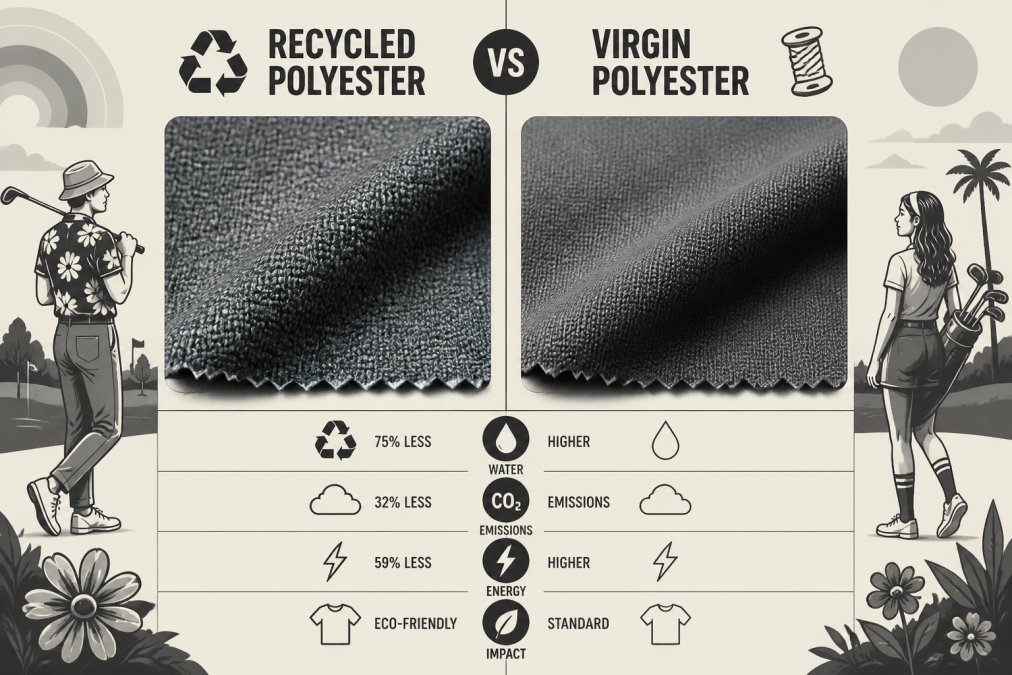
The core reason recycled polyester usually has a lower footprint: it skips crude oil extraction and initial polymerization, which are energy- and emissions-intensive. Mechanical recycling avoids most of that. Chemical recycling also skips extraction but adds energy back during deconstruction and re-polymerization, so its savings are smaller and depend heavily on the plant's energy source.
That's the mechanism. Now the caveats most write-ups skip.
The Assumptions That Change the Answer
A life-cycle comparison is only as honest as its boundaries. Here's what swings the result:
- Energy mix. A recycling facility on a coal-heavy grid may produce fiber with a footprint close to virgin; the same facility on renewables tells a very different story.
- Feedstock source. Bottle-derived recycled polyester (rPET) has a clearer savings profile than textile-derived, because textile waste is harder to sort, clean, and decontaminate.
- Transport. Bottles collected in one region and processed in another carry shipping emissions. Local loops beat global ones.
What We Can Say With Confidence
Given all that, here's what holds up:
- Recycled polyester generally requires less energy and water to produce than virgin, because it skips oil extraction and initial polymerization.
- The size of that advantage varies by method, energy source, feedstock, and transport, so any single "X% less" figure is a range, not a rule.
- Extending a garment's life is often more impactful than the recycled-versus-virgin choice itself.
Recycling Pathways and the Circularity Ceiling
Here's the part the peace-and-love version leaves out: polyester can't be recycled forever.
- Mechanical recycling, grinding and re-melting, shortens polymer chains with each cycle. After a few passes, fiber quality drops and the material is often downcycled into lower-grade products.
- Chemical recycling, deconstructing polyester to its monomers and rebuilding it, can produce virgin-quality fiber repeatedly, but it's more energy-intensive, more expensive, and still scaling.
- Blended fabrics are the problem child. A 60/40 poly-cotton blend is very hard to separate economically, so most blended garments can't be recycled into new polyester at all.
So when you see "recyclable" on a polyester garment, read it as "recyclable in principle, if the infrastructure exists where you live." That's not cynicism, it's the honest state of play.
End of Life: What Actually Happens
In practice, most polyester garments, recycled or virgin, end up in a landfill or incinerator, and textile-to-textile recycling is still limited.
Choosing durable, timeless pieces is the highest-leverage move, a garment you keep for years avoids the production footprint of every replacement you didn't buy. The retro hippie aesthetic of classic fits and space-dyed patterns is built to stay in rotation longer than fast fashion.
The Honest Bottom Line
Recycled polyester is generally the lower-impact choice, and a genuinely good one. But the biggest wins aren't in the fiber label, they're in wearing things longer, washing cooler, and buying from makers transparent about their supply chain. At Hippie Golf LLC, mindful, made-to-order production reduces waste before the garment ships, and our recycled performance polos are built to last seasons rather than a single summer.
Frequently Asked Questions
Is recycled polyester actually as durable as virgin polyester?
Recycled polyester performs comparably to virgin polyester in durability when properly constructed. The key factor is fabric weight and weave density, not the source of the fibers. Both recycled and virgin polyester can be engineered for high abrasion resistance and longevity. What matters most is the manufacturing process and quality control. Higher-grade recycled polyester, like what's used in performance golf apparel, can withstand repeated washing and wear just as well as virgin alternatives.
Does recycled polyester moisture-wicking performance differ from virgin polyester?
Recycled polyester and virgin polyester have virtually identical moisture-wicking capabilities when treated with the same hydrophilic finishes. The fiber structure that makes polyester hydrophobic is the same regardless of origin. Performance depends on the hydrophilic coating applied during manufacturing and the fabric construction. Both can deliver excellent sweat-wicking for active wear, keeping you dry on the course. The finish and yarn quality matter far more than whether the polyester started as recycled content or virgin material.
What certifications verify genuine recycled polyester content?
The Global Recycled Standard (GRS) is the most recognized third-party certification for recycled content. It verifies that recycled material actually comes from post-consumer waste and tracks it through the supply chain. Look for GRS certification when shopping for recycled polyester apparel to confirm authenticity. Other credible certifications include the Recycled Claim Standard (RCS) and industry-specific textile standards. These certifications help prevent greenwashing by requiring independent audits and transparent documentation of recycled fiber sourcing.
Does recycled polyester release more microplastics than virgin polyester?
Research suggests that recycled and virgin polyester shed microplastics at similar rates during washing. The shedding issue is inherent to polyester fiber structure, not its origin. Both types can release microfibers when laundered, though washing frequency, water temperature, and detergent type have more impact than whether the polyester is recycled or virgin. Using a microfiber-catching filter in your washing machine reduces shedding for any polyester garment, regardless of its source material.